Iran’s language of force in the Strait of Hormuz pays off
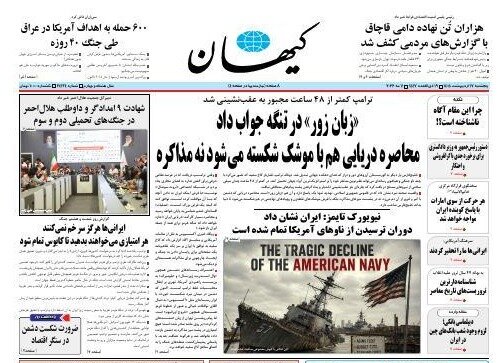
Kayhan published an analysis examining what it described as the 48‑hour failure of Trump’s ‘Freedom Project’ in the Strait of Hormuz. According to the article, the failure of this operation proved that Iran’s naval power cannot be shaken by propaganda. A blockade that began with pride was shattered by missiles, leaving ‘the language of force’ as the only valid response to Trump.
Trump believed he could impose his desired new order on the world’s most strategic waterway with a few warships and media noise, but within less than 48 hours, he received such a harsh blow from Iran’s armed forces that he had no choice but to retreat and hide behind contradictory statements. In the worldview of the Islamic Republic, threats have only one answer: ‘the language of force.’ The naval blockade boasted about by the enemy was not broken at negotiation tables but by precision missiles and attack drones—showing the world that the Persian Gulf has an owner.
Siasat-e-Rooz: The UAE has not yet been punished
Siasat-e-Rooz dedicated its editorial to what it described as Iran’s punishment of the UAE for cooperating with the United States and Israel in attacks against Iran. The UAE is acting outside regional frameworks and international law and must be held accountable. It states that Tehran is fully prepared militarily to deliver a harsh and crushing response to any reckless or threatening behavior by the UAE. Although the closure of the Strait of Hormuz to Emirati ships is already being implemented, these measures should be expanded so that the UAE’s leaders abandon their illusions. The UAE cannot claim neighborly ties with the Persian Gulf and Iran while acting against them. Relying on imagined support from the US and Israel has ended; control of the Strait of Hormuz is in Iran’s hands, and no regional equation can be shaped without Iran’s coordination. These are realities that everyone—including the UAE—must recognize and adjust their behavior accordingly.
Jam-e-Jam: Iran, a geopolitical bridge in the heart of Eurasia
Jam-e-Jam discussed the strategic importance of Iran’s geography and the need to use this position effectively. One of the key topics in the upcoming meeting between the US and Chinese presidents will be the consequences of the White House’s hostile actions against Iran. This meeting is a stage where both the future of the global power balance and the security dynamics of West Asia will be redefined. Iran’s geography makes it one of the most important routes connecting East and West, and the proper utilization of this position could turn Iran into a central hub of regional and global economic networks. The period before and shortly after the Beijing meeting is described as a limited window for influencing developments. If Iran can take the initiative during this time, agreements between the US and China may better account for Tehran’s interests. Iranian diplomacy should focus on several pillars: active engagement with China and Russia, presenting practical plans for stability in the Strait of Hormuz, and turning economic cooperation into long-term development projects.
Iran: Creating opportunities for Iran in Beijing
Shahrouz Shariati, a professor of international relations, spoke with the Iran newspaper about the significance of Araghchi’s trip to China amid heightened tensions with the United States. The visit is best understood as an attempt to exploit the growing gaps and competition among major powers. Under pressure, Tehran seeks to activate the capacities of actors like China to both manage the costs of the crisis and use Beijing’s geo-economic and diplomatic tools to contain instability. China, for its part, prefers a pragmatic, risk‑managed approach, playing the role of facilitator—maintaining stability in energy markets and preventing escalation, while avoiding confrontation with the US. Recent diplomatic movements should be understood within the broader transition toward a multipolar order and the redefinition of power balances in the Middle East.
Sobh-e-No: The UAE takes orders from London and Washington
Sobh-e-No interviewed Jafar Ghannadbashi, a regional affairs analyst, about the UAE’s role in the region. According to Ghanadbashi, the UAE does not take any significant or minor foreign policy action without receiving directives from the United Kingdom and the United States. Even cooperation with Israel or installing radar systems on Emirati soil to facilitate actions against Iran is all carried out with approval and planning from London and Washington. He compares this pattern to what he describes as the structure of the Israeli regime, which he says established itself through occupation and the ‘lie’ of land purchases. The UAE is essentially a network seeking the rights of a sovereign state so that the UK can use its vote and position in international organizations. The UAE has attracted various investments, including some Iranian capital, to create companies that advance foreign agendas.
Leave a Comment